
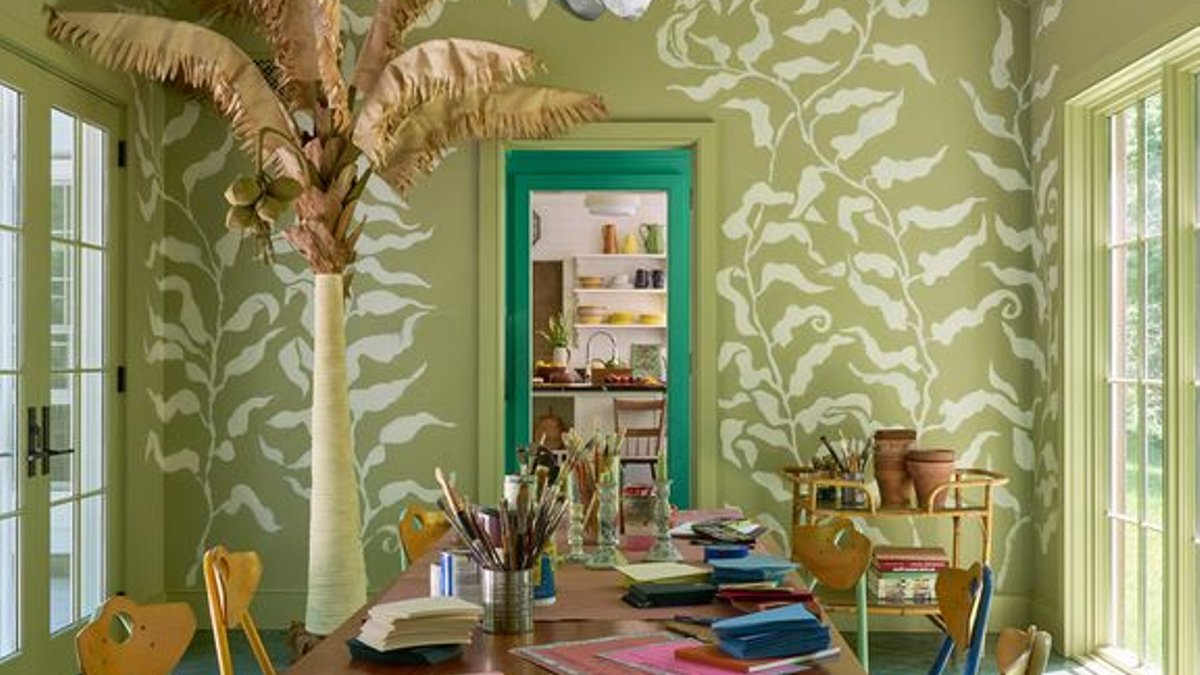
A protected stand of old-growth forest near Bedford, New York, surrounds an 18th-century farmhouse that artist Happy Menocal has transformed into a living art installation. Built around 1710, the house sits across from a rare woodland preserve—one of the last remaining in the northeast. Its walls hold centuries of history, from 19th-century expansions to a 1960s greenhouse now serving as a dining room. Menocal and her family moved in that August, drawn by the fairy-tale atmosphere and willing to endure the property’s drafty winters in exchange for its natural beauty.
For Menocal, the farmhouse serves as both home and studio, where her work merges aristocratic elegance with unexpected playfulness. Collaborations with brands such as Schumacher and Paperless Post have established her reputation for wedding stationery that nods to aristocratic traditions and medieval motifs. Inside the farmhouse, however, her creativity manifests differently: a chandelier fashioned from disposable aluminum lasagna trays, flattened and draped like a hula skirt over hanging lamps. The dining room walls, painted in lichen-green tones, are hand-painted with ferns that stretch from floor to ceiling, creating an immersive miniature forest for guests.
The renovation required careful balance between preservation and modernization. Architect Kirtley Cameron of Cameron & Corrigan Architects noted the house’s fragmented architectural history, beautiful yet structurally compromised in places. The team preserved exposed beams and uneven ceiling heights while upgrading insulation and energy efficiency. Menocal, known for designing custom materials when necessary, personally selected every tile, paint color, and fabric. Her mother, Katharine Barnwell, a decorative painter, contributed to the dining room’s distinctive features, including the lasagna-tray chandeliers.
The design philosophy rejects polished perfection in favor of raw character. A butler’s pantry painted in Farrow & Ball Arsenic green serves as a transitional space between the ethereal dining room and the bright kitchen. The library, nicknamed the “red room,” features Menocal’s Gloriette textile in a bold red shade, a long-held personal aspiration. The walls display pottery by friends Lyn and Will Reardon, paintings by Cameron Goodyear and Elizabeth Jaeger, and other works from her creative network. The result feels like a personal collection of influences.
A short walk through the woods leads to an 1870s mineral quarry, where rainbow-hued leaf litter and glittering veins of feldspar and mica create a natural, shimmering environment. Menocal spent her childhood exploring these woods, and their influence is reflected in the home’s design. Even the drafty kitchen, where coats hang year-round, becomes part of the narrative, a reminder that certain compromises are worthwhile for the right setting.


