
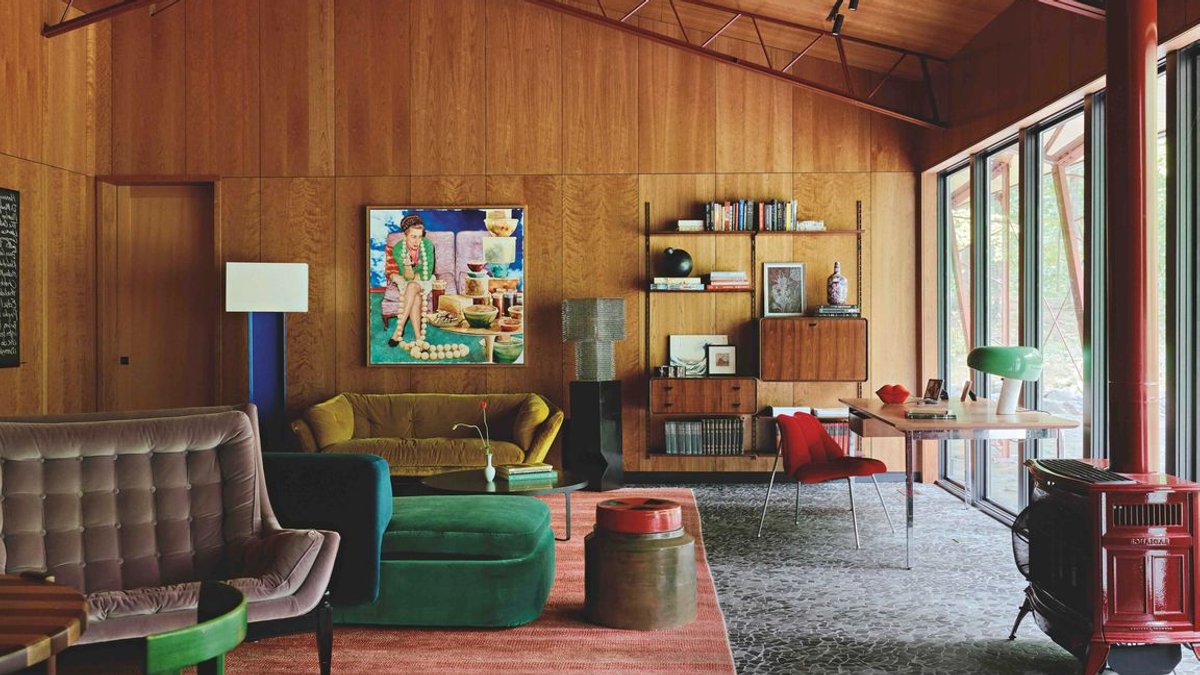
Sunshine Thacker, an internationally renowned ceramist, transformed a dream into a contemporary home nestled in upstate New York’s Hudson River region. The house, built in a clearing surrounded by maple trees, embodies her vision of a safe, warm space with wooden walls and golden light, a treasure chest full of meaning. She recalls closing her eyes and envisioning a place that was both modern and nostalgic, an elongated space offering warmth and diffuse, golden illumination.
Its design blends modern elements with nostalgic touches, using glass, iron, and wood to create a seamless whole. The materials chosen reflect her initial vision, forming a structure that feels both intentional and organic.
Design Inspired by Modernist Principles
Thacker’s home draws inspiration from mid-century modernist projects, particularly Jean Prouvé’s Demountable House and the Case Study houses in California. A painted steel skeleton serves as both structure and decoration in an homage to Jean Prouvé’s projects like the Demountable House (1944) and the House of Better Days (1956), establishing a garnet-red modular grid that defines the exterior and interior rhythms. This grid not only provides functional support but also acts as a visual anchor, echoing Prouvé’s emphasis on industrial precision and adaptability.
In the living room, Kim Dreyer’s painting The Party Is Over Darling guides the chromatic and compositional choices. Velvet seating, lighting, and other furnishings reflect the artwork’s colors and shapes, creating a dialogue between emptiness and fullness. Thacker harmonized existing pieces, including her mother-in-law’s Chippendale-style chair and a vermilion rug, into the space’s design. The painting’s bold forms influence the room’s layout, ensuring that every element, from the furniture to the lighting, works in concert to amplify its visual language.
Personal Touches and Cultural Influences
In the bathrooms, walls are entirely clad in tiles reflecting her son’s childhood drawings. These surfaces become repositories of memory and emotion, transforming the house from an abstract dream into a tangible place that reflects personal history. The home, designed not to impress but to reassure, captures a rare familiarity that transcends memory. Thacker’s design philosophy prioritizes color, material, and room to breathe, using instinct to craft symbols and subtle references. Each element, from the steel frame to the handmade tiles, contributes to a home that celebrates both personal and shared histories.


