
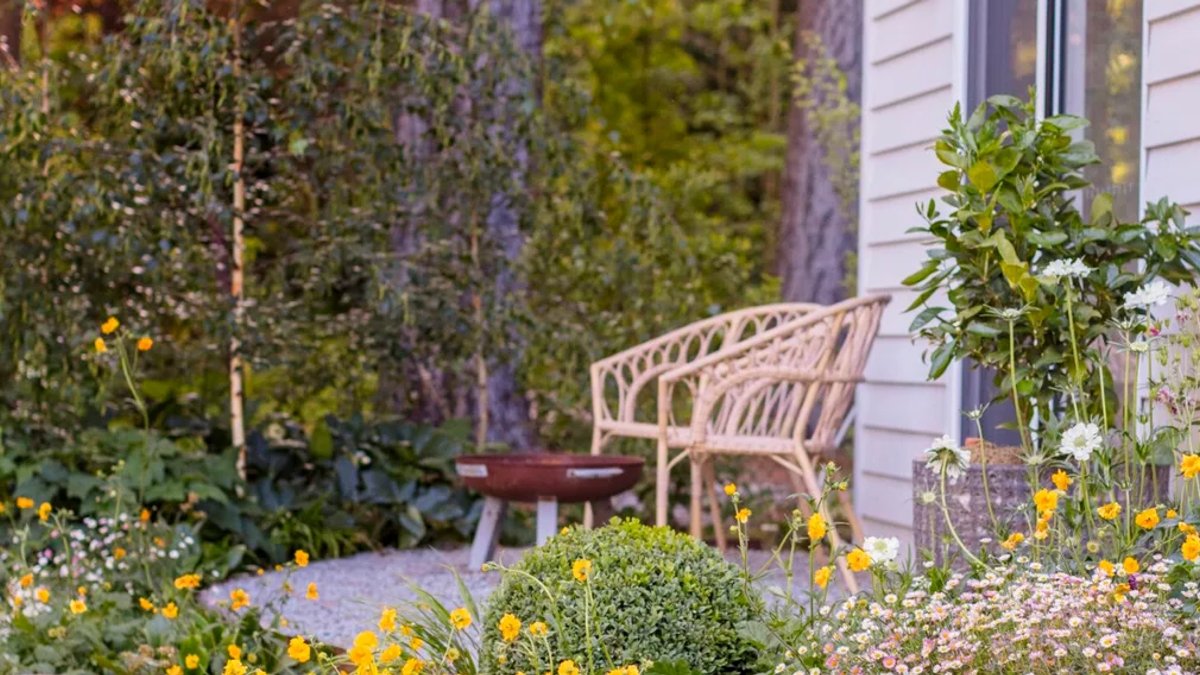
The garden at Virginia’s cottage in Macedon, Victoria, is designed not just to be admired but to be lived in. The front garden, a Tim Pilgrim-designed naturalist space featured in Home Beautiful’s March 2024 issue, wraps the cottage in clouds of blowsy blooms, while the back garden—completed in early 2025—ties the whole together with a philosophy of pottering: a space where work and relaxation blur.
Virginia, an enthusiastic amateur gardener, didn’t start with a grand plan. Her first move was practical: raised vegetable beds and compost bins in the backyard. “I did that to get some vegies and be able to get my hands dirty while I worked out what I wanted to do everywhere else,” she says. The front garden took shape next, but the back remained a blank slate until Tim Pilgrim returned to refine it. His design incorporated Virginia’s wish list, spaces for growing, harvesting, and simply wandering, while echoing the front garden’s cottage-style charm.
“It was the final piece of the puzzle,” Tim Pilgrim says. “Tying together a garden that we were really proud of.” The result is a environment where being and doing coexist. Steps carved from a single basalt boulder lead away from a gravelled patio, flanked by shrubs that seem to emerge from the earth itself. Flowering plants—pinkladies, seaside daisies, Aquilegia ‘Rose Queen’, and alliums, spill across the space, their blooms staggered to ensure year-round interest.
Seasonal blooms replace each other naturally
The design avoids rigid formality. Structured evergreens, like clipped Buxus balls, provide a backbone, but the rest is wild: seasonal blooms that rise and fall in dominance. “It’s not all singing, all dancing, right through the year,” Tim Pilgrim explains. “One thing replaces another, each taking turns in being dominant.” Hard materials, basalt boulders, stone steps, and puddle pavers, are secondary to the plants, except for the Sproutwell ‘Orangery’ glasshouse, raised on red brick footings to mirror the front garden’s brick patio. The glasshouse, Virginia’s favorite spot, even has a bed for her dog, Harvey.
Shade plays a key role. Towering pine trees along the fence line cast filtered light, shaping the garden’s dark corners. Birch trees thrive there, their pale trunks contrasting with the acidic soil. Beneath them, Penstemon ‘Husker’s Red’ and Heuchera ‘Black Forest Cake’ ground the space in deep maroon, while Penstemon ‘Pink Cloud’ and Scabiosa caucasica ‘Perfecta Alba’ punctuate the shadows with bursts of color.
Cutting garden blends beauty with function
A cutting garden sits snug against the glasshouse, currently a sprawl of sweetpeas. Virginia plans to rotate crops, dahlias in summer, seasonal favorites as the mood strikes. “I love these hardworking spaces,” Tim Pilgrim says. “We were able to blur the lines between a pretty place to ‘be’ and a place to ‘do.’” The garden’s basalt ‘puddle’ pavers connect the zones, guiding visitors past the vegetable patch, the glasshouse, and the cutting garden.
Related Post: 2026 Design Trends Show Home Evolution
This isn’t just a garden; it’s a working system. Virginia moves between spaces with a coffee in one hand and a trowel in the other. The vegetable beds, the sweetpeas, the dahlias, each has a purpose, yet none feels like chores. The design ensures that even mundane tasks, like checking the vegie patch or harvesting flowers, feel like part of the joy.
For Virginia, the garden is a slice of heaven. She takes her coffee outside to watch the sweetpeas climb, to decide what to plant next, or to let Harvey nap in the glasshouse.
The back garden’s palette mirrors the front, but with intentional twists. Geum ‘Lady Strathden’ and seaside daisies spill over boulders. Every choice serves a function: shade tolerance, seasonal interest, or simply the pleasure of a trowel in the soil.
A garden that feels like home
The garden’s success lies in its duality. It’s both a retreat and a workshop, a place to sit and a place to work. The materials, basalt, brick, glass, are chosen for their practicality as much as their aesthetics. The plants are selected not just for their looks but for their resilience, their ability to thrive with minimal fuss. And yet, the result is anything but utilitarian. It’s a garden that feels like a second home, where every path invites exploration and every bed tells a story.
The back garden’s completion in early 2025 was the final touch. Virginia will keep planting, pruning, and rotating crops.


