
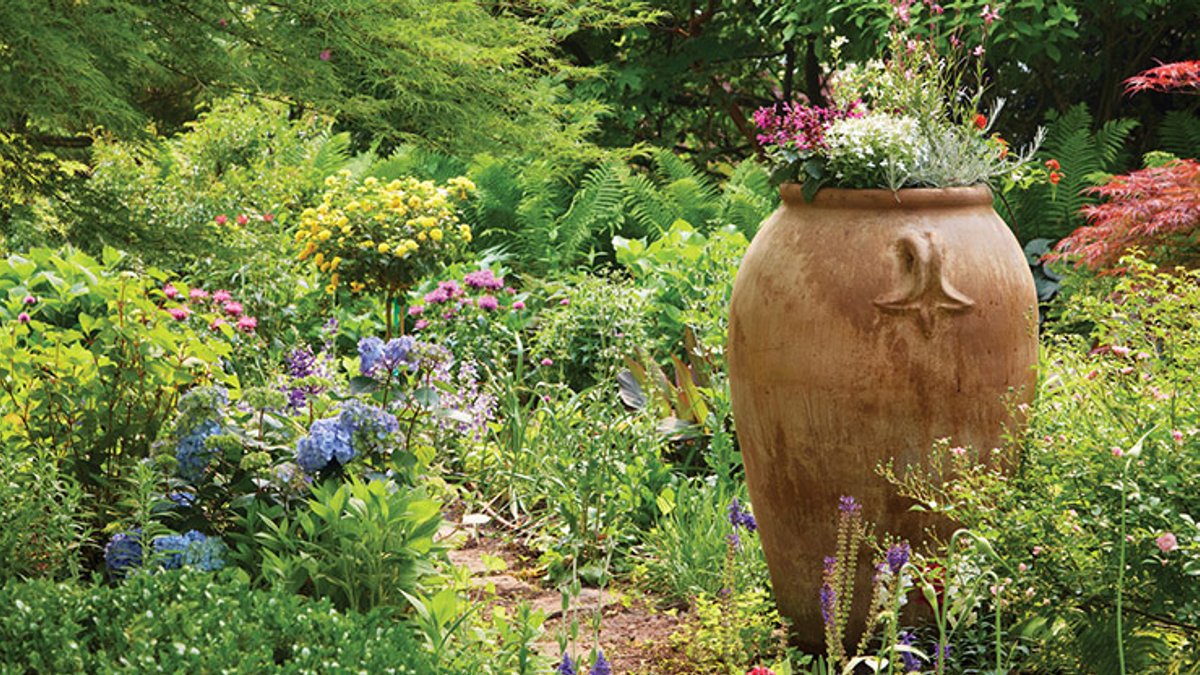
Creating a flower-filled front yard from scratch takes time, patience, and a strategy for dealing with wildlife. Ellen Goldfarb, who has lived in her New Jersey home for 40 years, started with a simple lawn and some standard shrubs before transforming the space into a cottage-style border along the driveway. Over the decades, she added more garden beds, removed lawn, and eventually started a garden design and maintenance firm with her daughter, Tracy Buttrick. The result is a terraced garden that functions almost like a stage for the plants.
Managing the Slope and Structure
A sloping front lawn originally defined the space, but Ellen had a curving 1-foot-tall stone wall installed to divide the 56-foot-wide by 35-foot-deep yard. This change created three distinct terraces that manage the slope and allow plants to show off better. The garden features a mix of Japanese maples, boxwoods, hydrangeas, and flowering shrubs. Ellen relies on evergreens like ‘Wintergreen’ Korean boxwoods, Japanese plum yew, and deodar cedar to frame the more exuberant plantings on each level.
Related: Online Bright-Hosta Seeds: Fact vs. Fiction
While Ellen loves flowers, she prioritizes structure. She places evergreens and structural plants first when designing a new garden, creating a framework for the flowers to follow. Supporting plants include black-eyed Susans, ornamental grasses, hydrangeas, and ostrich ferns. Chartreuse-foliaged plants, such as hakonechloa, frequently appear in these arrangements because they make the surrounding greenery pop.
Even with a diverse plant palette, wildlife management remains a constant challenge. Deer are voracious pests that have eaten through gardens in the past, particularly when food sources are scarce. The gardener has experimented with various methods to protect her plants and those of her clients. She found that evergreen shrubs like boxwoods, many junipers, and cherry laurel tend to be deer-proof, along with bigleaf hydrangeas and roses like those in the Drift series.
While deer often avoid these specific varieties, some years are worse than others. Last year, a persistent doe and her two fawns ate black-eyed Susans and heleniums, which they usually avoid.
Related: Floral Photographer Finds Self in Blooms
Ellen has compiled a list of deer-resistant flowers to help other gardeners manage their own [gardens][1]. These selections offer reliable blooms and are less likely to become a meal for local wildlife.
- Helenium (Helenium spp. and hybrids): These long-blooming perennials tolerate heavy soil well and produce yellow, orange, or red daisy-shaped flowers from summer to fall.
- Calamint (Calamintha nepeta): The white, frothy flowers of ‘Montrose White’ bloom from May through frost and complement a variety of other plants.
- Allium (Allium spp. and hybrids): After the purple lollipop blooms of ‘Millenium’ fade, the dried seedheads still provide garden interest into late summer.
- Angelonia (Angelonia angustifolia): These everblooming flowers come in white, purple, pink, or raspberry and rarely fall over, performing well with or without deadheading.
- Salvia (Salvia spp. and hybrids): Hummingbirds adore the tubular flowers of salvia, especially the red varieties, which bloom from summer through fall.
Ellen Goldfarb’s journey highlights the beauty and difficulty of native plant design. She balances structure with color, ensuring that every season offers something new to see. Her terraced garden stands as a sign to careful planning and resilience against nature’s challenges.


